Living With Cerebral Palsy, as an oldie.
The first thing I want to say about living with Cerebral
Palsy is that fundamentally, it is a pain in the backside. Now that I am a
permanent wheelchair user, one area that I have to be acutely aware of is pressure
points on my bottom. This may not be a highly sociable topic, but it is
absolutely crucial to a sense of well-being. I have a very good new pressure
cushion that, when you undo it, looks like many miniature teabags. But as you
move, the pressure points change. You would think that because these teabags
are quite hard, it would be extremely uncomfortable, but quite the opposite. It
is much better than my originally hard gel cushion.
I digress at this point because I am not talking about
Cerebral Palsy in old age. But being comfortable is absolutely essential to
well-being.
I was born weighing just 2lb at birth; I could literally
lay on the doctor's hand because I was so small. Doctors told my parents that I
was dead and that they should come over and say goodbye to me. My mother heard
a tiny squeak just like a mouse, and she called the doctors back, and they
realized I was barely breathing. All hell broke loose, and I was quickly put in
an oxygen tent and rushed to the premature baby unit. Where I stayed for some
three months until I weighed 5lbs and was able to go home. I did not have an
auspicious start to my life. In fact, when I was 18 months old, my mother was
told by a doctor, “take her home, forget about her, she’ll never be any good.
You’re wasting my time, your time, and everybody else's. This child is
spastic.” How I hate that term of calling someone a spastic; to me, it is as
derogatory as it can get. Though sadly, that was the way doctors referred to
people with disabilities in the '50s, and I was born in 1950.
Specialists told my parents that I would not live beyond my
teens, and it was always said in my presence. So I grew up thinking that I was
going to die anytime soon. As the years went on, I realised that I had not met
with their conviction. This kid was not going to leave this world too quickly.
Indeed, I am now 74 years of age, still working, still writing, and still
trying to change the attitudes that have been formulated in people's minds
regarding Cerebral Palsy. I still have a great deal of work to do. I will not
give up until I take my last breath. But I pray that won’t happen for a while
yet.
Mobility as a child was virtually non-existent. My body was
just like a rigid board due to Cerebral Palsy spasms. My legs were scissored,
one leg over the other, and my mother tells a story of trying to put a nappy on
me, which she said was like prizing my legs open as though they were a piece of
wood, and to get a nappy on me was almost impossible. Obviously, my mother
succeeded, and we were very grateful for cotton nappies because they could be
boiled and therefore eliminate some of the risk of infection.
My mother was a great one for massage; she consistently
massaged my neck, spine, arms, and legs. Gradually, I began to turn my head and
look towards objects.
My mother realised that I had no sight in my left eye due
to Retrolentalfibroplasia, which is a burning of the back of the eyes due to
oxygen damage. This was discovered by an Australian doctor who took 14
premature babies, bandaged the eyes of 7, and left the others uncovered within
the oxygen tanks. The uncovered babies became totally blind, whereas the first
7 had perfect sight—What a discovery. Now there is virtually no specialist
education for the blind or indeed specialist schools. I went to one in 1966,
and fortunately, due to having a good brain, I was able to learn braille, learn
to play the flute, and sing like a bird. Sadly, that is not the case today; I
am somewhat rusty with old age. But I still love to sing, even if it is just
for me.
My life changed when I went to the Bobath Centre, now known
as the National Bobath Cerebral Palsy Centre, with Nancy R. Finnie. She was a
wonderful Bobath therapist who started her life in a children’s hospital,
having learned about the “Bobath Approach”; she then took me with her to the
Bobath Centre where I became her training module. I was fortunate that I had
suddenly learned to speak at the age of 4, and mercifully, my speech was
perfect. No problems with Cerebral Palsy there! How grateful I am for that. I
have watched and listened to many people with Athetoid Cerebral Palsy who
struggle to formulate their words, have constant movement of their head and
hands, and obviously look as though they are severely affected with Cerebral
Palsy. Because I was able to articulate well, doctors at the Bobath Centre
wanted to hear what I had to say and see how I responded to certain tasks. I
was never able to draw; that was probably due to my sight loss. But I had
perfect articulation, and my mother always insisted that I spoke politely and
correctly to doctors and therapists. So I was an extremely good role model. The
“Bobath Approach” is one of total commitment. Parents had to agree to carry out
physiotherapy for two and a half hours a day—every day. Roberta Bobath, the
founder, was absolutely rigid on this point. If you were not prepared to make
the commitment, then the child with a disability would not be able to stay in
the system. Miss Finnie worked me incredibly hard, trying to implant normal
patterns of movement. For example, there was one simple task I had to cope
with, namely washing my face. This should be a simple task, taking a few
seconds, but for me, it was impossible. I would take my face to the face cloth
rather than bringing the cloth to my face. To begin with, I couldn’t see what
the problem was, so they showed me over and over again until my brain suddenly
got the idea, and I was able to perform this task successfully and the right
way round. What a victory!
Everything about Cerebral Palsy is small victories,
suddenly being able to move or roll onto your side and to crawl on hands and
knees, all done with the Bobath planting positions of good movement, again and
again. So that my brain got the message, and I was eventually able to crawl.
This was my means of mobility until the age of 11 when I had a hamstring
transplant on both legs, spending 6 months in plaster from thighs to toes. With
a plank of wood, rather like a broom handle, between my knees, keeping my legs
apart from one another. For this reason, I had to have my bed put next to my
parents, who would alternatively get out of bed and turn me over either from my
back or to my stomach. It was in the days of the old heavy plaster; the weight
of my legs was extremely heavy. I think this was where I first developed
problems with my sacrum and the pain that I have always experienced. After
surgery (one year later), I took my first steps with tripod sticks—just four
steps. But they were my giant leap for mankind. I could suddenly stand, and
more importantly, move on two sticks for the first time in my life—what a
victory. I can remember that my parents, brothers, and myself were standing
hugging each other with tears streaming down our faces. I had done it. Then two
years later, I had a detached retina out of the one eye I could see out of. I
became totally blind. I felt terrified to move, yet I had to go up and down the
stairs, and I was terrified that I would veer too much to the left and fall
down the flight of stairs. But somehow I managed it. Once I started at Dorton
House, School for the Blind, my life took off, and I was able to take flute
examinations with the Royal Academy of Music and I was to develop my singing
doing pieces from Handle Messiah.
When I left Dorton, I trained as a telephone switchboard
operator and worked for a bank in the City of London. The Commonwealth Trading
Bank of Australia was delighted to help me raise money for tailgates on
ambulances to help ferry people around with all kinds of disabilities. We took
people out every week to places of interest, restaurants, cinema, and other
activities. For the first time, they were not disabled people but people first
and people with disabilities second. They learned to have fun for the first
time in their lives, and they grasped every minute of it.
So what did this do for me in terms of going out and about,
meeting people, and projecting my work to improve the lives of people with
disabilities? Due to my blindness, I was always anxious about how I would cope,
especially finding my way to the toilet and managing at the food table. But
somehow I got through it. Naturally, there were people that were not
sympathetic when it came to helping me manage my food in a busy place. But I
coped with it because I wanted to get out there and socialise. You don’t realise
how hard it is until you are put in a position when you can’t do things or go
to places by yourself. It is a terribly frustrating time for a person with a
disability, and many of those feelings are still there today because society
doesn’t really cope well with people who are different.
In 1985, I met the man who was going to be part of my life
for the next 24 and a half years. We married in 1987. We were deeply in love
with one another, and he coped with all of my issues superbly until he became
profoundly disabled with Parkinson’s disease and subsequently Lewy-body
Dementia. Ralph died in 2011.
My life radically changed, and I then had to have 24/7
live-in carers, and the cost has been astronomical.
For those of us who are unable to propel themselves in a
wheelchair and have to wait for others to move us, that too is incredibly
frustrating. I now have a specialist wheelchair that is molded to my body to
help me sit up straighter. That is wonderful, and I am now in less pain due to
taking Gabapentin in liquid form (I cannot swallow pills) three times a day.
Although Gabapentin is a tremendous help, I am always conscious that it is an
addictive drug and would not wish to be on it from choice. Also, I now have to
be hoisted from bed to chair or chair to toilet. For that reason, I now have to
use incontinence protection because it would take far too long for me to get
hoisted and manage the toilet successfully. All of this is enormously
frustrating and costly. Government funding only meets about 1/3 of the costs of
incontinence such as pads, sheets, etc. Also, while much can be provided by the
GP in terms of creams, I prefer to use more natural healing products such as
Aloe jelly and Bee Propolis cream, but all of these are expensive and add to my
overall care costs as well as coping with my contribution to Adult Social Care
Services which now charge me £1337.78 per month. I have already bought my home
twice over in care costs. These are the hidden issues that most people have no
knowledge of. They will find that out in later life when they too may need
care. So my message is to keep as healthy as you can, as mobile as you can, and
keep an active mind for as long as you can. For all of these things will help to
keep you out of a residential care home. I am not decrying residential
care—some people have a great need for it. For those, there is no option. But
for those of us that are now in the later stages of our lives, we should be
looking at our homes, thinking about adaptations, and whether more thought can
be given to such things as wider doorways and ramped access. Those things may
keep you out of a care home for now at least. So good luck with all of it
because you are going to need it!
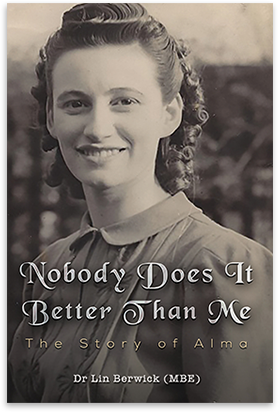
To read more about how Cerebral Palsy shaped my life and
how I coped with disabilities growing up, then read “Nobody Does It Better Than
Me. The Story of Alma. An inside to mine and my families life. Available on all
major book retailer websites.
Dr Lin Berwick MBE
Post Views : 263